
Before You Call It Fraud: Building a Clean Documentation File on a Suspicious Florida Rental Application
Before You Call It Fraud: Building a Clean Documentation File on a Suspicious Florida Rental Application
You approved an applicant, handed over the keys, and moved on. Weeks later, something does not line up. The employer on the pay stub is not the employer on the application. A reference phone number now belongs to someone who has never heard of your tenant. The move-in date on a prior landlord letter conflicts with the dates the applicant listed. Your first instinct may be to say "this is fraud" and look for the fastest way out.
That instinct is understandable, but it is also where many property owners and managers create problems for themselves. Florida law now gives landlords a specific notice pathway tied to certain fraudulent conduct in obtaining a tenancy. Whether that pathway fits your situation is a legal question for your attorney, and the attorney's answer depends heavily on what is in your file and how that file was kept.
This article is about the file. It is not a test for deciding whether fraud occurred, and it is not legal advice for your specific property. It is a practical recordkeeping framework that helps your counsel review the situation clearly and helps you avoid steps that could undermine your position.
Here's what you need to know.
What Changed in Florida on October 1, 2026
As of today, October 1, 2026, Chapter 2026-143, Laws of Florida, is in effect. This is the enacted version of CS/HB 1293 from the 2026 legislative session. You can read the full text at laws.flrules.org/2026/143.
What Chapter 2026-143 Does
At a high level, the chapter does two things that matter to residential landlords:
- It establishes an offense involving knowing and willful fraudulent conduct connected to entering into a tenancy.
- It amends section 83.56(2)(a), Florida Statutes, to add that specified conduct as a ground for a seven-day termination notice, effective October 1, 2026.
It is important to be precise here. Seven-day noncurable termination notices are not new in Florida. They existed under section 83.56(2)(a) before this law for other categories of serious noncompliance. What the 2026 amendment does is add the specified fraudulent-entry conduct to the list of grounds that can support that type of notice.
What the Chapter Does Not Do
The statutory text has real limits that you should understand before acting on it:
- It does not define evidentiary standards. The chapter does not tell you how much documentation is enough or what a court will consider persuasive.
- It does not provide court procedure guidance. Nothing in the chapter walks you through how a case will move once it is filed.
- It does not come with case outcomes. Because the provision took effect today, there is no body of court decisions applying it yet.
There is also a practical research point. If you look up section 83.56 on the Florida Senate website, the page currently reflects the 2025 codification of the statute. The 2026 amendments may not yet appear in that online version. Do not assume the new ground is absent just because you do not see it there, and do not rely on the codified page alone. Your attorney should review the enacted chapter text directly.
A Quick Note on Bill Numbers and Other Rumors
You may see references to SB 1224 in industry chatter. SB 1224 was not the bill that became law; the operative law is Chapter 2026-143, derived from CS/HB 1293. You may also have heard that Florida changed its nonpayment notice to five days. That is not accurate. SB 716, which proposed that change, died on March 13, 2026. The three-day nonpayment notice under section 83.56(3), which excludes Saturdays, Sundays, and legal holidays, remains in place.
Getting these details right matters because a notice built on the wrong statute or the wrong timeframe can create avoidable problems for your case.
Why Recordkeeping Comes Before Conclusions
When a discrepancy surfaces, the natural reaction is to reach a conclusion quickly. But your role at this stage is not to decide whether fraud occurred. Your role is to preserve an accurate, organized record so the person qualified to make that judgment, your attorney, can do so.
Your File Is Not a Verdict
A documentation file is a collection of facts and records. It shows what was submitted, what was noticed, when, and by whom. It does not prove intent, and "knowing and willful" conduct is a concept that involves intent. There are many reasons a document might not match an application, and some of them are innocent: a recent job change, a payroll company name that differs from the employer's trade name, a clerical error, or a reference who simply changed phone numbers.
Your attorney weighs those possibilities. Your file gives them the raw material to do it.
How Files Get Compromised
In practice, documentation problems tend to follow familiar patterns:
- Someone annotates the original application with handwritten notes or highlights.
- Emails are forwarded, edited, or deleted while staff discuss the issue.
- Multiple team members save different versions of the same document in different places.
- Notes mix observations with opinions, such as "obviously fake," written next to factual entries.
- Nobody remembers when the issue was first spotted or who spotted it.
Each of these can make a clean review harder. The five steps below are designed to prevent them.
Step 1: Preserve Original Materials in Unaltered Form
Start by locking down everything the applicant submitted and every communication you exchanged, in the exact form you received or sent it.
What to Preserve
- The completed rental application, whether paper or electronic
- Supporting documents submitted with it, such as pay stubs, bank statements, offer letters, or prior landlord references
- Any consent forms or authorizations the applicant signed
- Emails, text messages, and portal messages with the applicant
- Your screening criteria and the approval record, as they existed at the time
- The signed lease and any addenda
How to Preserve It
Keep originals untouched. Do not write on, highlight, staple notes to, or re-save original documents. For electronic files, keep the original file as received rather than a re-exported or edited version.
Make working copies and store them separately. If you need to review, mark up, or share materials internally, use copies. Store those copies in a different folder or location from the originals so there is never confusion about which version is authentic.
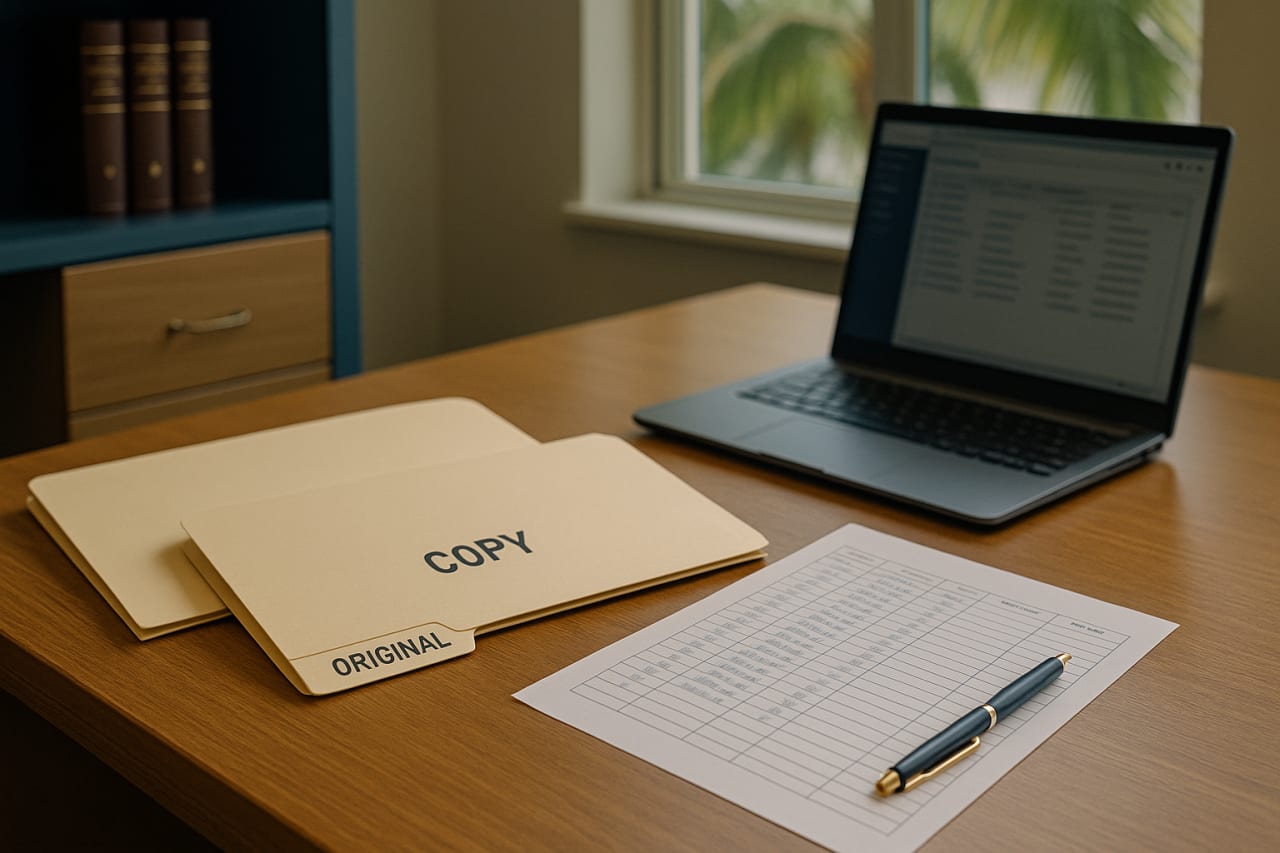
Label clearly. A simple naming system such as "ORIGINAL" and "COPY" in file names or folder names prevents accidental edits.
This step is ordinary good recordkeeping. You are not gathering new information; you are protecting what you already have.
Step 2: Keep a Dated Discrepancy Log
Memory is unreliable, especially when several people touch a file over several weeks. A dated log creates a contemporaneous record of how the issue came to light.
What Each Entry Should Include
- Date and approximate time the discrepancy was noticed
- Who noticed it, by name and role
- How it was noticed, for example "while reviewing the file for a lease renewal" or "when a returned piece of mail arrived"
- Which document or communication is involved, referenced by its file name or description
- A short factual description of the discrepancy
Example Log Entry
March 4, 2026, approximately 10:15 a.m. Noticed by the leasing coordinator while preparing the renewal file. The employer name on the pay stub dated January 15, 2026, does not match the employer name listed in Section 3 of the application.
Notice that this entry describes what was seen and nothing more. It does not speculate about why. Entries like this are easy for your attorney to evaluate because they are clear, dated, and attributable.
Keep the log as a running document and add new entries rather than rewriting old ones. If an earlier entry contains a mistake, add a correction with its own date instead of deleting the original line.
Step 3: Record Observations Separately From Conclusions
This is the step that most often separates a useful file from a problematic one. Your file should describe what is observable. Conclusions belong to your attorney and, ultimately, to a court.
Observations Versus Conclusions
Here are some side-by-side examples:
- Observation: "The pay stub employer name does not match the employer listed on the application." Conclusion to avoid: "The tenant committed fraud."
- Observation: "The phone number listed for the prior landlord reference reached a person who stated they did not recognize the applicant's name." Conclusion to avoid: "The reference was fake."
- Observation: "The monthly income stated on the application is higher than the gross pay shown on the two submitted pay stubs." Conclusion to avoid: "The applicant lied about income."
Why This Matters
Conclusory language can make a file look like it was assembled to support a predetermined outcome. Factual language lets the record speak for itself. It also protects you if the discrepancy turns out to have an innocent explanation, which is a real possibility you should keep in mind.
If team members have opinions or theories, that is fine, but keep them out of the core file. If something needs to be communicated to counsel, it can be raised directly with your attorney.
Step 4: Limit Changes to the File and Track Access
Once the file is organized, treat it as a controlled record. The fewer people who touch it, and the better you can show who did, the more reliable it is.
Practical Access Controls
- Designate a file owner. One person should be responsible for maintaining the file and adding new materials.
- Restrict access. Limit the file to the people who genuinely need it, such as the property manager, the owner, and counsel.
- Keep an access record. Note who opened, added to, or copied the file and when. Many shared drives and document management systems record this automatically; if yours does not, a simple manual log works.
- Freeze originals. Use read-only settings where available, or store paper originals in a secure location.
- Add, do not alter. New information gets added as a new dated item. Existing items are not edited or replaced.
Stay Within Ordinary Recordkeeping
This framework is about organizing records you already have in the normal course of business. It is not a suggestion to launch your own investigation, run additional searches, or contact third parties to build a case. If your attorney believes more information is needed, let them decide what is appropriate and how to obtain it.
Step 5: Send the Organized File to Counsel
With originals preserved, a dated log in place, observations separated from conclusions, and access controlled, you are ready to hand the file to your attorney.
What Your Attorney Decides
Your attorney, not your leasing team, determines:
- Whether the facts may fit the conduct described in Chapter 2026-143
- Whether the amended section 83.56(2)(a) seven-day notice is appropriate, or whether another notice or no notice at all fits better
- How any notice should be drafted and delivered
- What happens next if the occupant does not leave
How to Make the Handoff Efficient
- Include a short index listing every document in the file
- Provide the discrepancy log as a separate document
- Include a copy of the lease and your screening criteria
- Note any communications with the tenant since the discrepancy surfaced
- Avoid sending a narrative full of conclusions; let the organized file do the work
A well-organized file can make the legal review more efficient. It does not guarantee any particular result.
What a Clean File Cannot Do: Notice Is Not Possession
This point deserves its own section because it is where landlords most often get into trouble.
A File Does Not End a Tenancy
Your documentation file supports a legal review. By itself, it does not terminate a tenancy, and it does not give you the right to retake the unit. Even a properly drafted and properly delivered seven-day notice is only a notice. It starts a statutory process; it does not hand you the keys.
Possession Generally Requires a Court Action
If the occupant remains in the unit after a notice period expires, physical possession generally requires a court eviction action. In Florida, a landlord regains possession from an occupant who will not leave through the court process, ending with a writ of possession executed by the sheriff. There are situations where possession changes hands without a contested case, such as a tenant who voluntarily surrenders the unit, and Florida law contains other specific exceptions. Whether any of those apply to your situation is a question for your attorney.
Never Use Self-Help
No matter how strong you believe your file is, do not take matters into your own hands. Section 83.67, Florida Statutes, prohibits landlord self-help measures, including:
- Changing the locks or otherwise locking the tenant out
- Shutting off or interrupting utilities such as water, electricity, or gas
- Removing the tenant's belongings or removing doors, windows, or appliances outside the court process
Self-help can expose you to liability and can seriously damage your legal position, even if the underlying concern about the application turns out to be well founded. The new fraudulent-entry ground does not change this. A suspicion of fraud is not a license to bypass the courts.
What To Do Now
Here is a practical plan you can put in place, whether or not you have a suspicious file on your desk today.
This Week
- Pause before reacting. If a discrepancy has surfaced, stop and avoid any confrontation, threats, or changes to the tenant's access or utilities.
- Secure the originals. Gather the application, supporting documents, communications, and lease. Store originals separately from working copies.
- Start the discrepancy log. Record when each issue was noticed, how, and by whom, using factual language only.
- Contact your attorney. Let counsel know you have a file to review under the law that took effect October 1, 2026.
This Month
- Create a written recordkeeping procedure. Document how your team preserves applications, names files, and separates originals from copies.
- Train your staff on observation-only language. Walk through examples like the ones above so everyone understands the difference between a fact and a conclusion.
- Set access controls. Configure your shared drive or filing system so sensitive tenant files have a designated owner and limited access.
- Review your notice and delivery workflow with counsel. Confirm who drafts notices, who delivers them, and how delivery is documented.
This Quarter
- Audit your application retention practices. Make sure your normal process already preserves materials in a way that would hold up if questions arise later.
- Update your internal templates. Add a standard discrepancy log template and file index to your property management toolkit.
- Reinforce the no-self-help rule. Put a written policy in front of every manager and maintenance team member confirming that lockouts, utility shutoffs, and removal of belongings are prohibited.
- Stay current on the statute. Ask counsel to keep you informed as the amended section 83.56 appears in updated codifications and as courts begin applying the new ground.
The Bottom Line
When a rental application raises red flags, your job is to keep a clean, factual, well-controlled record, not to decide whether fraud occurred. A properly organized file helps your attorney determine whether Chapter 2026-143 applies and which notice, if any, is appropriate. Remember that notice is not possession: if an occupant stays, regaining the unit generally runs through the courts, and self-help is never the answer.
Ready When Your Attorney Sets the Course
Once your counsel decides on the right notice and next steps, accurate delivery and clear documentation become critical. Headley Legal Support Services helps Florida landlords, property managers, and law firms with the delivery and documentation of eviction notices and court papers in the Hallandale Beach area and beyond. Visit headleylegalsupport.com to learn how we can support your eviction process with careful, well-documented service.
This article provides general information about recordkeeping practices and Florida law as of October 1, 2026. It is not legal advice. Consult a licensed Florida attorney about your specific situation.