
Wrong Address, Wrong Name, Dismissed Case: Why Florida Courts Are Cracking Down on Sloppy Service Details
Wrong Address, Wrong Name, Dismissed Case: Why Florida Courts Are Cracking Down on Sloppy Service Details
Have you ever watched an entire case fall apart because someone typed "North" instead of "Northeast" on an address? Or listed "Avenue" when the county records clearly show "Street"? It sounds absurd, but it happens every single week in Florida courts. And increasingly, judges are refusing to look the other way.
If you are a paralegal, legal secretary, or office manager responsible for sending service packets out the door, this post is for you. The five-minute verification steps outlined below can save your firm from embarrassing (and expensive) service failures. And if you think you do not have time for these checks, stick around. There is a real story here about what happens when a law firm pushes back on basic verification and how that argument played out.
Here is what you need to know: Florida courts are tightening their scrutiny of service details, process servers are rejecting sloppy paperwork before it even hits the field, and the responsibility for getting it right falls squarely on the people preparing those documents.
The Real Problem: A Law Firm That Refused to Double-Check
Let me paint a picture of how this plays out in the real world. Not long ago, we had several service attempts come back rejected. Not because the process server could not find the address. Not because the person was hiding. The addresses were simply wrong.
In one case, "the northeast was missing the north, you know, it only stated north and the northeast, or the place was actually street or whatever it was whatever variation. And what's happening is a lot of these courts are hammering down on that."
So we brought it back to the law firm. We told them the addresses needed to be verified against county records before filing. The response from the paralegal handling the cases? She said she did not have time to verify every address that came in on a spreadsheet. She admitted she was copying addresses straight from whatever the client sent, pasting them into the filings, and shipping them out to us.
That is a problem. A big one.
The argument got heated, to put it mildly. Her position was that she did not see a specific Florida statute requiring address verification. Our position was that it does not matter what the statute says in black and white when case law is full of motions to quash based on exactly these kinds of errors. A judge looking at a proof of service where the address does not match the property appraiser records has every reason to toss it.
Why Process Servers Are Pushing Back
Here is the thing that a lot of law firms do not realize: process servers are now the ones catching these mistakes. And many of them are refusing to go out on jobs with questionable details.
Process servers do not want to deal with a motion to quash. They do not want to pause their workday to sit through a Zoom deposition about whether they served the right address or the right entity. So they are doing exactly what they should be doing: checking the details before accepting the job.
"I have one process server in Tampa that basically requires us whenever we send them work, if it's a corporation, we want a SunBiz report, we want this, we want that, we want everything."
And honestly, you cannot argue with that approach. That Tampa process server, whose company owner happens to be the vice president of the Florida Association of Professional Process Servers, is checking every box that is supposed to be checked. The rest of the industry got lazy, and now courts are making everyone pay for it.
When your process server sends the job back to you with a request for better documentation, that is not them being difficult. That is them protecting your case, your client, and themselves.
What Florida Courts Are Actually Scrutinizing
So what exactly are judges looking at when they evaluate whether service was proper? It comes down to a few key details that seem minor until they become the reason your case gets dismissed or delayed.
Address Accuracy
This is the number one issue we see. The address on the service documents must match the official records for that property. Not what Google Maps says. Not what the client scribbled on an intake form. The property appraiser's records for that county.
Common errors include:
- Directional prefixes: "N" instead of "NE," or "North" instead of "Northeast"
- Street type: "Avenue" instead of "Street," or "Drive" instead of "Boulevard"
- Unit or suite numbers: Missing entirely, or using "Apt" when the records show "Unit"
- Spelling variations: Especially on streets named after people or landmarks with unusual spellings
- Zip code errors: Particularly in areas where zip codes have changed or split
Any one of these discrepancies gives opposing counsel an opening to file a motion to quash service. And in 2026, Florida judges are granting those motions more often than ever.
Entity Name Verification
When you are serving a corporation or LLC, the entity name on the service documents must match the name registered with the Florida Division of Corporations (SunBiz). This means if the business does business as "Smith Construction" but is registered as "Smith Construction Services, LLC," you need to use the registered name.
This also extends to identifying the correct registered agent. Most companies either register themselves, hire an attorney, or use a service like CT Corporation (which acts as registered agent for thousands of companies, particularly in Broward County). If you are serving a corporation and you have not confirmed who the current registered agent is through SunBiz, you are rolling the dice.
The Registered Agent Service Window
Here is something many paralegals and legal secretaries may not know: Florida recently expanded the window during which registered agents are supposed to be available for service. It used to be strictly 10 AM to 12 PM. Now, the statute also includes 2 PM to 4 PM.
That does not mean registered agents are always available during those hours. They are definitely not. But knowing these windows matters for your process server and for the record of diligent attempts.
The 5-Minute Verification Checklist That Prevents Service Failures
Here is the good news. Catching these errors before they become problems is not complicated. It does not require special software, a law degree, or even a call back to the client.
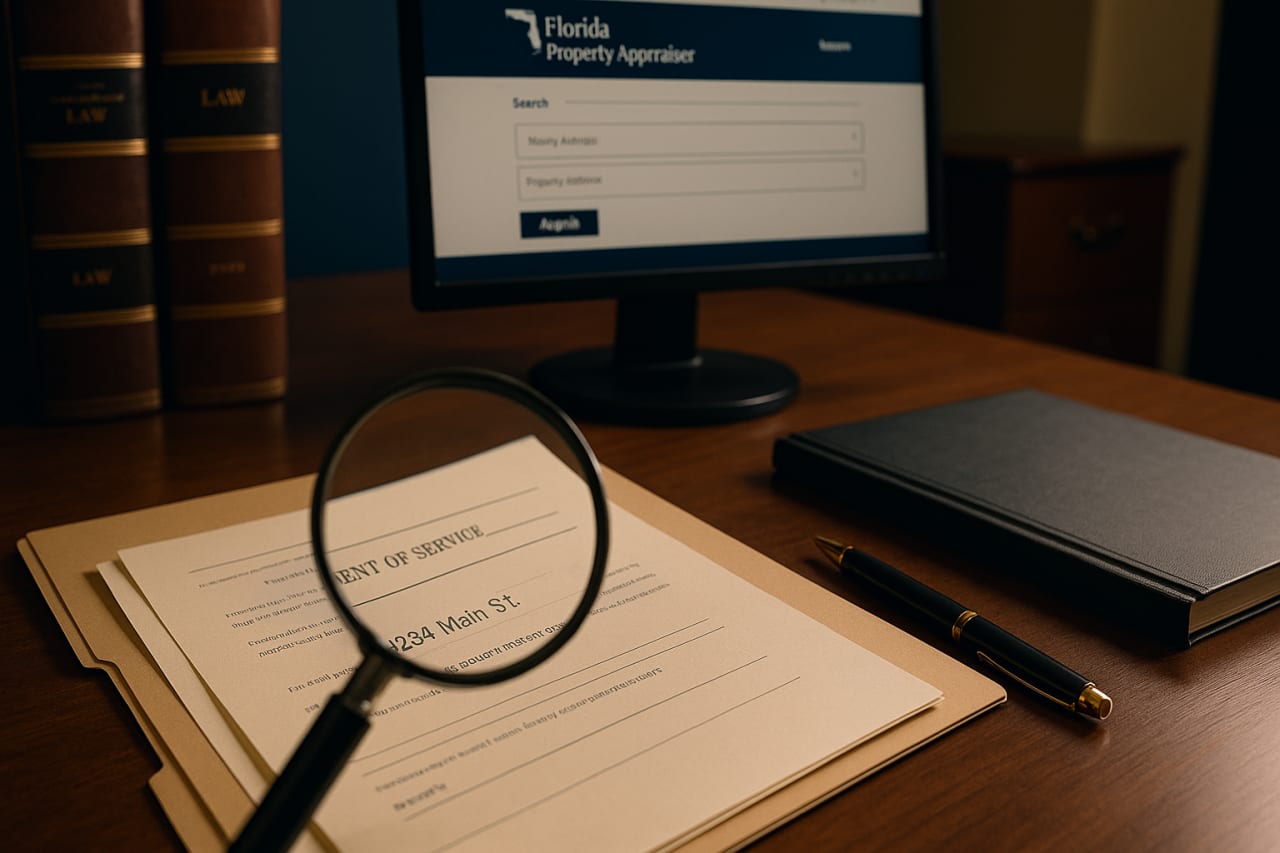
"It's very simple. Double-check the address. Go into the property appraiser of the county that we're trying to serve. Double-check the address. You don't have to go back to your client."
That is it. Five minutes of due diligence can save weeks (or months) of delays, re-service costs, and potential case dismissal. Here is a step-by-step checklist you can print out and keep at your desk.
Step 1: Verify the Physical Address (90 seconds)
Go to the property appraiser website for the county where service will occur. Every Florida county has one, and they are all free to search. Enter the address as you have it and compare it against the official records.
Look for:
- Correct directional prefix (N, S, E, W, NE, NW, SE, SW)
- Correct street type (St, Ave, Blvd, Dr, Ct, Ln, Pl)
- Correct spelling of the street name
- Unit, suite, or apartment number if applicable
- City and zip code match
If anything is different from what you received from your client, update your filing to match the property appraiser records. Do not go back to the client and ask. The county records are the standard.
Step 2: Confirm the Entity Name on SunBiz (90 seconds)
If you are serving a corporation, LLC, or any registered business entity, go to sunbiz.org (the Florida Division of Corporations website). Search for the entity by name.
Verify:
- The exact legal name of the entity, including "Inc.," "LLC," "Corp.," etc.
- Active vs. inactive status of the entity
- The current registered agent name and address
- The principal office address if different from the registered agent address
Print or save the SunBiz report. Attach it to the service packet. Your process server will thank you, and if the service is ever challenged, you have documentation showing you verified the entity before service.
Step 3: Cross-Reference the Named Party (60 seconds)
Make sure the person or entity named in the lawsuit matches the person or entity you are actually trying to serve. This sounds obvious, but when you are processing 30 service requests from a spreadsheet, mistakes happen.
Ask yourself:
- Does the defendant's name match what is on the complaint?
- If it is a business, is the business name on the complaint the same as what SunBiz shows?
- Is the registered agent the same person listed in your records, or has it changed?
Step 4: Format the Address to USPS Standards (30 seconds)
Use the USPS address lookup tool (tools.usps.com) to standardize the address format. This gives you the official USPS-recognized format, including proper abbreviations and the ZIP+4 code.
This step is quick and eliminates formatting inconsistencies that can cause confusion during service.
Step 5: Document Your Verification (30 seconds)
Keep a brief note in your file: "Address verified against [County] Property Appraiser on [date]. Entity verified on SunBiz on [date]." That is it. If the service is ever challenged, you have a contemporaneous record showing due diligence was performed.
Total time for all five steps: roughly five minutes.
Why This Matters More in 2026 Than Ever Before
The Florida Association of Professional Process Servers (FAPS) is raising the bar across the industry. They are taking over process server training in Miami-Dade County, implementing a 16-hour course for new process servers and a 4-hour continuing education requirement for renewals. Since the pandemic, process server education had become, frankly, inadequate. People were getting licenses without any real training. That is changing.
But here is the thing that keeps getting overlooked: process server education only fixes one side of the equation. The other side is the law firms sending out the work. If a paralegal or legal secretary is copying addresses off a client spreadsheet without verification, the best-trained process server in the state still cannot fix that problem. They can only send it back, which costs everyone time and money.
The FAPS board is actively discussing how to educate law firms on proper service preparation. There is genuine interest from attorneys in receiving this training, particularly for their support staff. The paralegals and legal secretaries are the ones who really need to know this stuff, because they are the last line of defense before a service packet goes out the door.
The Real Cost of Getting It Wrong
When service details are wrong, the consequences cascade:
- Rejected service attempts: The process server sends the job back, and you lose days.
- Failed service: The server attempts service at the wrong address, and you have paid for nothing.
- Motion to quash: Opposing counsel challenges the service, and now your process server may have to testify in a Zoom deposition instead of doing their job.
- Case delays: Re-service means restarting timelines, which can push hearings and deadlines.
- Client frustration: Your client is paying for work that has to be done twice (or more).
- Potential dismissal: In the worst cases, bad service can lead to a case being thrown out entirely.
All of this is avoidable with five minutes of verification.
What to Do Now
Here is a practical timeline for getting your office's service preparation process up to standard.
This Week
- Print the 5-step checklist above and put it next to every workstation where service documents are prepared.
- Bookmark the property appraiser websites for the counties you most frequently serve in. For South Florida, that means Broward, Miami-Dade, and Palm Beach at a minimum.
- Bookmark sunbiz.org and the USPS address lookup tool.
- Review your current open service requests for any address or entity discrepancies before they go out.
This Month
- Audit your last 30 days of service requests. How many came back rejected? How many had address or name issues? Track the numbers so you have a baseline.
- Set up a standard operating procedure that requires the 5-step verification before any service packet leaves the office. Make it a firm policy, not a suggestion.
- Talk to your process serving company about what documentation they need. Ask them directly: "What do you want us to include with every service request?" Some companies, particularly in Tampa and South Florida, now require SunBiz reports for all corporate service.
This Quarter
- Arrange a training session for your paralegals and legal secretaries on service preparation best practices. This can be a lunch-and-learn, a Zoom session, or even a session facilitated by FAPS instructors.
- Establish a feedback loop with your process serving company. If jobs are coming back for corrections, you want to know why so you can fix the root cause.
- Review your firm's motion to quash exposure. How many motions to quash has your firm faced in the last year? What percentage were related to service details? That number should be trending toward zero.
The Bottom Line
Florida courts are no longer tolerating sloppy service details, and process servers are refusing to accept jobs with unverified addresses and entity names. The fix is simple: five minutes of verification using free, publicly available tools can prevent rejected service attempts, motions to quash, and case dismissals. Make it a standard part of your workflow today, not after the next case gets kicked back.
If your firm needs reliable process serving backed by thorough verification and real-world experience, reach out to Headley Legal Support Services. We will make sure your service gets done right the first time.